

Honestly, the patients who ask me the most questions about dental implants are never the ones who read too much. They are the ones who are quietly scared and trying not to show it.
They sit down, they ask something small and then slowly the real question comes out. Will it hurt? What if it goes wrong? These are not silly questions. They are the questions every sensible person has before agreeing to anything that involves a dentist and a surgical procedure in the same sentence.
So I am going to answer them. Not the way a brochure would. The way I actually talk to patients when they are sitting across from me.
Are Dental Implants Very Painful?
Someone told you something. A friend, a relative, someone in a Facebook group. And now the phrase dental implants painful has been living rent-free in your head.
Here is the truth. During the procedure, you are fully numb. Local anaesthesia takes care of that completely. What you feel on the chair is pressure and some movement. Not pain.
After the numbness fades, yes, the area is sore. Swollen for a couple of days. Tender when you eat. That is real and I am not going to pretend it is nothing. But almost every patient I have treated has said the same thing after: That was way easier than I thought it would be. Some compare it to a tooth extraction. A bit more, maybe. But not dramatically more.
And if you have genuine anxiety about sitting in the dental chair, sedation is an option. It is not just for dramatic cases. It is there for anyone who needs it.
What if my body rejects the implant?
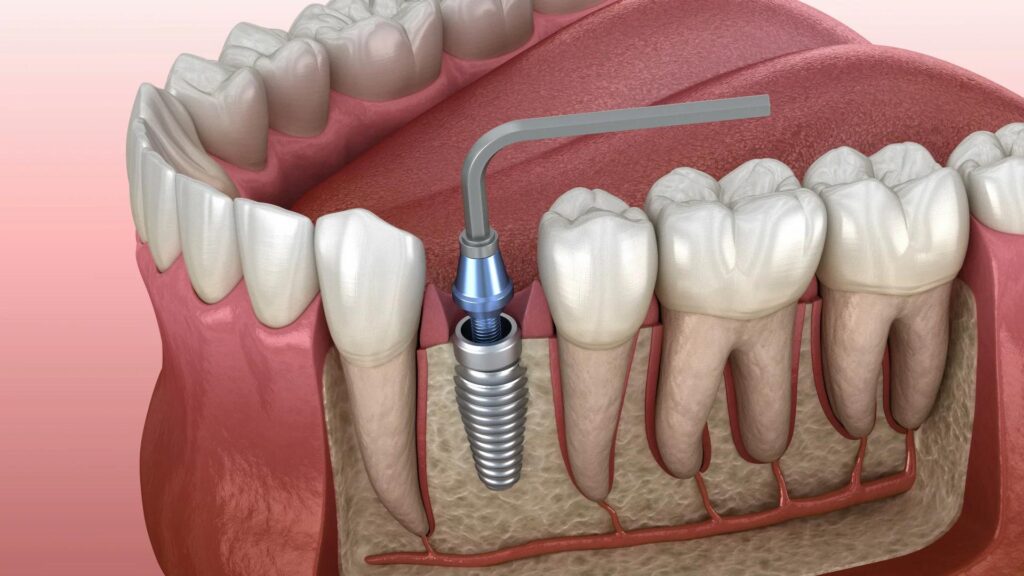
The body rejecting dental implants the way it might reject a transplanted organ is not really how this works. Implants are made from titanium, which is one of the most biocompatible materials in existence. Orthopaedic surgeons use it in knee and hip replacements. The immune system largely ignores it.
What can happen is that the implant does not fuse properly with the jawbone. That process, called osseointegration, is what gives the implant its stability. It can be disrupted by heavy smoking, poorly controlled diabetes, significant bone loss, or not following aftercare properly. These are all things your dentist checks for before recommending the dental implant procedure. A good consultation is specifically designed to catch the risk factors before they become problems.
The timeline is so long. Months and months.
I get it. You came in hoping for something that could be sorted quickly and someone handed you a calendar that stretches across most of the year.
But here is what that timeline actually looks like. The number of appointments you actually attend is not large. What stretches the process out is the healing time between them, particularly the period where the bone fuses around the implant post. You are not in the chair for six months. You are going about your life for six months while your jaw does the work.
And what you end up with after that wait is a tooth that is fixed into the bone, feels like your own tooth and with proper care can last the rest of your life.
I am probably too old for Dental Implant Procedure
No upper age limit exists for dental implants procedure. I have placed implants in patients in their late seventies. Some of the most motivated, most satisfied patients I have had are older, because they have spent years managing around missing teeth and they know exactly how much it has affected their daily life.
What matters is bone health and general health. Not age. Your dentist assesses those things through a proper examination and scan. Your birthday is irrelevant.
The Dental Implant Process is Too Expensive
Dental implants cost more upfront than a bridge or dentures. That is a fact and I will not dress it up.
But here is what the cheaper options cost you over time. Dentures need relining and eventually replacing. Bridges put strain on the teeth on either side of the gap. Neither of them stops bone resorption, the process where the jaw bone volume and jaw bone density in the gap area quietly decrease year after year because there is no root stimulating the bone anymore. That bone loss changes the shape of your face over time. It shifts your other teeth. It creates future dental problems that cost money to fix.
An implant stops all of that. It sits in the bone like a natural root and preserves what is there. When you factor in long-term oral health and what you would spend maintaining alternatives over a decade or two, the implant is often the better financial decision. Not always. But more often than people realise when they are only looking at the first invoice.
What if something goes wrong during the procedure?
The dental implant procedure has been performed routinely for decades. Success rates are consistently above ninety percent in well-selected candidates. The risks are real but they are also known, well-studied and significantly reduced when the procedure is properly planned.
Before any implant surgery, a CBCT scan is taken. It is a three-dimensional image of the bone, the nerve pathways and the sinus spaces. Your dentist maps the anatomy precisely before making a single incision. Nothing is done blind.
If you have a health concern, bring it up. A good dentist will either address it confidently or refer you to someone better placed to handle the complexity. Both outcomes protect you.
I just want it to look like a real tooth.
It will. When a dental implant is done properly, the crown on top is made to match your surrounding teeth in colour, shape and size. Most people genuinely cannot identify which tooth is the implant, including the patient themselves after a while.
Beyond appearance, there is something else worth knowing. Because the implant post sits in the jawbone and stimulates it the way a natural root does, the bone in that area does not deteriorate the way it does when a tooth goes unreplaced. The face holds its shape. That matters more than people expect until they see what long-term tooth loss does to someone’s face over time.
One Last Thing
Every fear on this list is valid. None of them are silly. All of them come from somewhere real, past experience, things people have heard, or just the completely reasonable anxiety of agreeing to a procedure you do not fully understand yet.
What they are not is a reason to stay stuck. Every single one of them is answerable. And you deserve actual answers, not vague reassurances designed to get you to sign a consent form.
At Smile Signature Dental Clinic in Kolkata, we make time for these conversations. You bring the doubts. We will be straight with you about all of it.
Come in. Ask everything. Leave knowing what is actually right for you.
Frequently Asked Questions
Soreness and swelling for two to three days is normal. Most patients find it far more manageable than expected and handle it well with basic pain relief.
Usually three to six months for a straightforward case. Longer if bone grafting is needed first. Most of that time is healing, not clinic visits.
Often yes, though bone loss may mean grafting is needed first. A scan at your consultation will clarify exactly what is required.
Yes. The crown is custom-made to match your surrounding teeth. Most people cannot tell the difference at all.
No upper limit. Bone health and general medical condition matter far more than age.